A city built across ridges, valleys and a plateau edge
Chattanooga lies in what geologists call the Valley and Ridge: long parallel ridges and valleys running northeast, with the Tennessee River cutting across them. Along the west side stands Walden Ridge, the edge of the Cumberland Plateau, more than a thousand feet above the valley floors, and south of the river Lookout Mountain rises the same way.
Each of those three settings has its own rock, its own soil and its own way of troubling a house.
The valleys: clay over limestone
A U.S. Geological Survey study of the Hixson side of the city puts it plainly: limestones and dolomites are the principal rocks, and sinkholes, solution channels in the limestone and a thick layer of weathered material are found throughout the area. Limestone dissolves slowly in groundwater, so its upper surface is not flat. It is a field of pinnacles and pockets hidden under the soil.
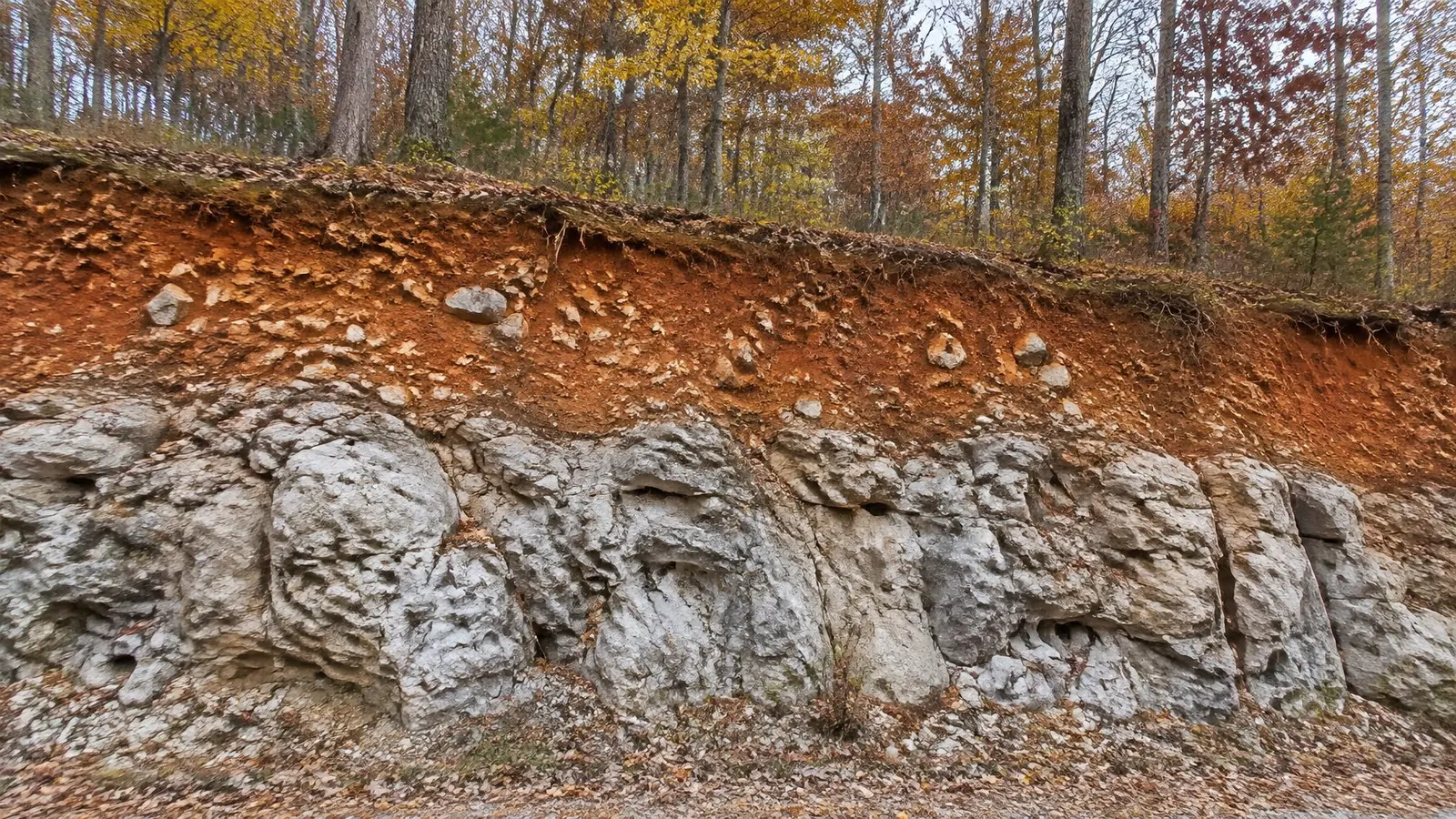
The soil on top is mostly clay left behind as the rock dissolved. The federal soil survey names one such soil after Collegedale, where it was first described: the Collegedale series, a clayey soil weathered from limestone that lets water through at a moderately slow rate. The survey notes that a fairly large acreage of it in Hamilton County has been built on.
For a foundation this means two things. Footings on one house can bear on clay of very different depths, shallow over a rock pinnacle at one corner and deep over a pocket at another. And clay that drains slowly stays soft and heavy against walls and under footings well after the rain has stopped.
The ridges: deep red clay full of chert
The rounded ridges that run through the city are dolomite that has weathered in place, leaving a blanket of red clay studded with hard chert gravel. It can be remarkably deep. In the same USGS study, nineteen wells drilled on and near Cave Springs Ridge passed through an average of 124 feet of chert and clay before reaching rock, with a range from 16 feet to nearly 300.
This matters when a repair involves piers. A pier is driven or drilled until it reaches material firm enough to carry the load, and on a ridge lot the depth to that material can change a great deal over a short distance. It is one reason two neighbors can receive very different proposals.
Ridge lots are also sloping lots. Builders cut into the uphill side and push the spoil downhill to make a level pad, so part of the house stands on undisturbed ground and part on fill.
The mountains: sandstone and steep ground
Signal Mountain and Lookout Mountain are different again. The plateau surface is capped with sandstone, shale and conglomerate, rocks that the USGS describes as generally unaffected by the dissolving that shapes the limestone valleys. Sinkholes are a valley concern far more than a mountain-top one.
On the mountains the usual causes are the slope and the water. Houses perch on steep lots with tall downhill foundation walls, and heavy rain runs off quickly. Erosion under a footing, a retaining wall under strain and fill creeping downhill are the things an inspector looks for there.
Rain, drought and the swing between them
The Chattanooga area normally receives about 52 to 53 inches of rain a year, according to the same USGS report. The total matters less than the swing. That report records four years in the 1980s that ran 6 to 13 inches below normal, followed by a year of more than 71 inches.
Clay shrinks as it dries and softens as it wets. A long dry spell pulls soil away from footings; the wet season that follows loads walls and saturates the ground under shallow piers. Cracks that open in a dry autumn and tighten by spring are following that cycle.
How this helps on the phone
Tell the company where the house sits: valley floor, ridge side or mountain. Mention whether the lot was cut and filled, how tall the downhill wall is, and whether the house has a crawl space, a basement or a slab. Those few facts tell a local company a good deal before it arrives.