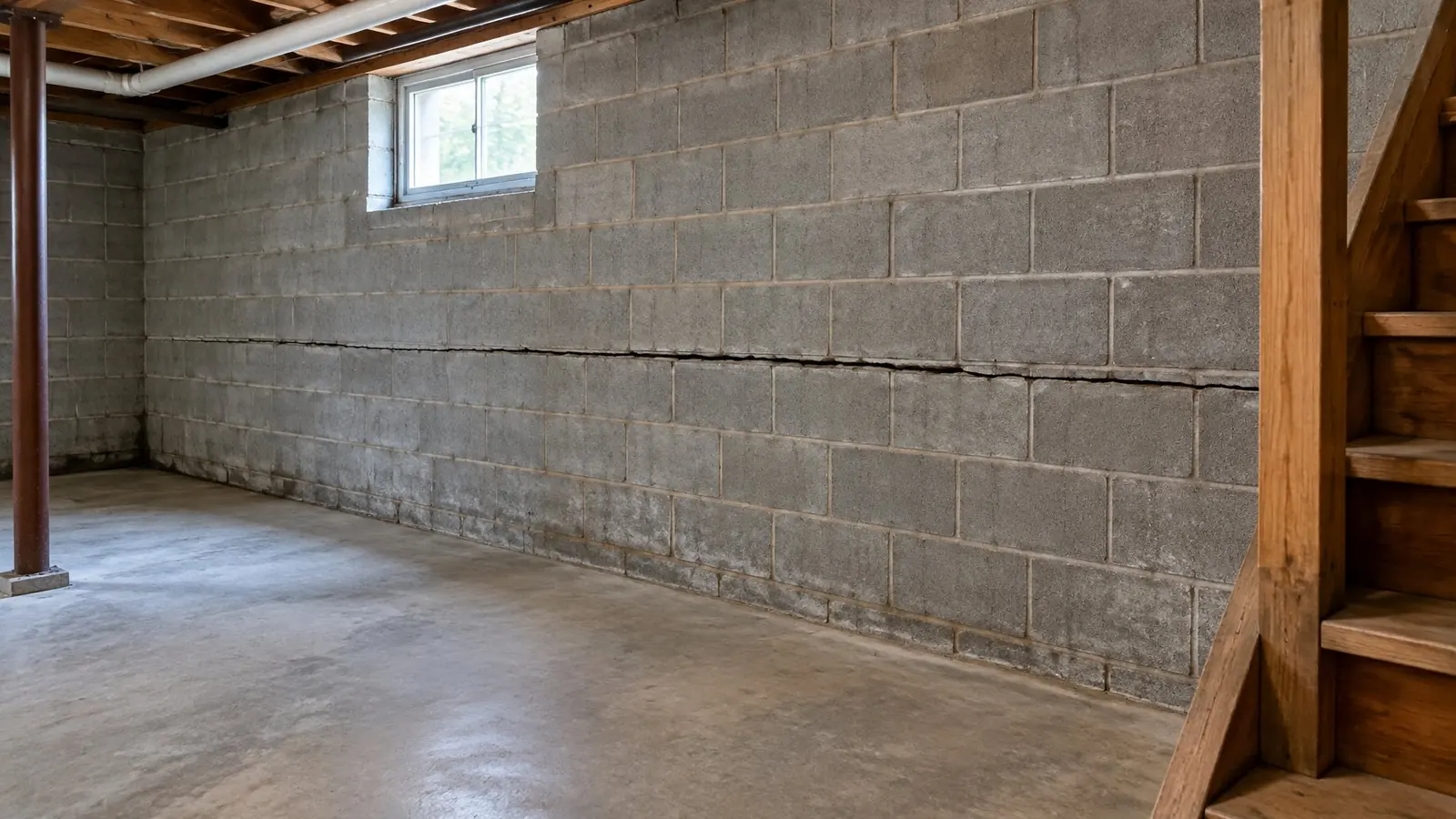
Which way does it run?
Direction is the quickest guide to what made a crack, because each kind of force breaks a wall in its own way.
- Vertical or nearly so, hairline, in a poured concrete wall. Concrete shrinks as it cures and often cracks like this within the first years. These are common, and many only matter if they leak.
- Stair-step through the joints of a block wall. One section of footing has moved relative to the next. Wider at the top usually means the end of the wall is dropping.
- Horizontal, along a mortar joint, partway up a block wall. Soil is pushing the wall inward. This is the pattern to have looked at promptly, and it has its own page on bowing basement walls.
- Across a slab floor. Thin, flat cracks in a basement or garage slab are often shrinkage. A crack with one side higher than the other means the ground under the slab has moved.
Block, poured concrete and stone behave differently
Houses around Chattanooga have all three. Concrete block is common in basements and crawl space walls built in the middle of the last century. Newer houses more often have poured concrete. The oldest ones may stand on stone or brick foundation walls laid in soft lime mortar.
A block wall is hollow and jointed, so it cracks along the joints and can bend. Poured concrete is one piece and tends to crack cleanly. Old stone walls rarely show a single crack; the mortar washes out and stones loosen instead. Tell the company which you have when you call, because it shapes what they bring to the visit.
What is measured at a cracked wall
- Width, top and bottom
- With a crack gauge or feeler, recorded so that a later visit can compare.
- Offset across the crack
- Whether one face has moved in, out, up or down from the other.
- Plumb and straightness of the wall
- A long level or a laser shows any lean or bulge the eye misses.
- Water marks and soil staining
- White mineral crust, rust lines and silt show how long water has been using the crack.
- What is outside that spot
- A downspout, a low flower bed, a tree, a driveway that drains toward the house.
How cracks are usually repaired
The repair follows the cause. Filling a crack that is still moving only hides it for a season.
| Situation | Common approach | Worth asking |
|---|---|---|
| Stable hairline crack in poured concrete that seeps | Injection with a flexible polyurethane or a rigid epoxy resin from the inside | Which resin, and why that one for this crack |
| Stair-step cracking where a footing has settled | Piers under the settled section, then repointing the joints | How many piers and how depth will be decided |
| Horizontal crack with the wall pushed in | Bracing, anchors or reinforcing strips; rebuilding if it has gone far | Whether an engineer has sized the repair |
| Slab crack with one side dropped | Lifting the slab with injected grout or foam, or replacing the section | What is causing the void under it |